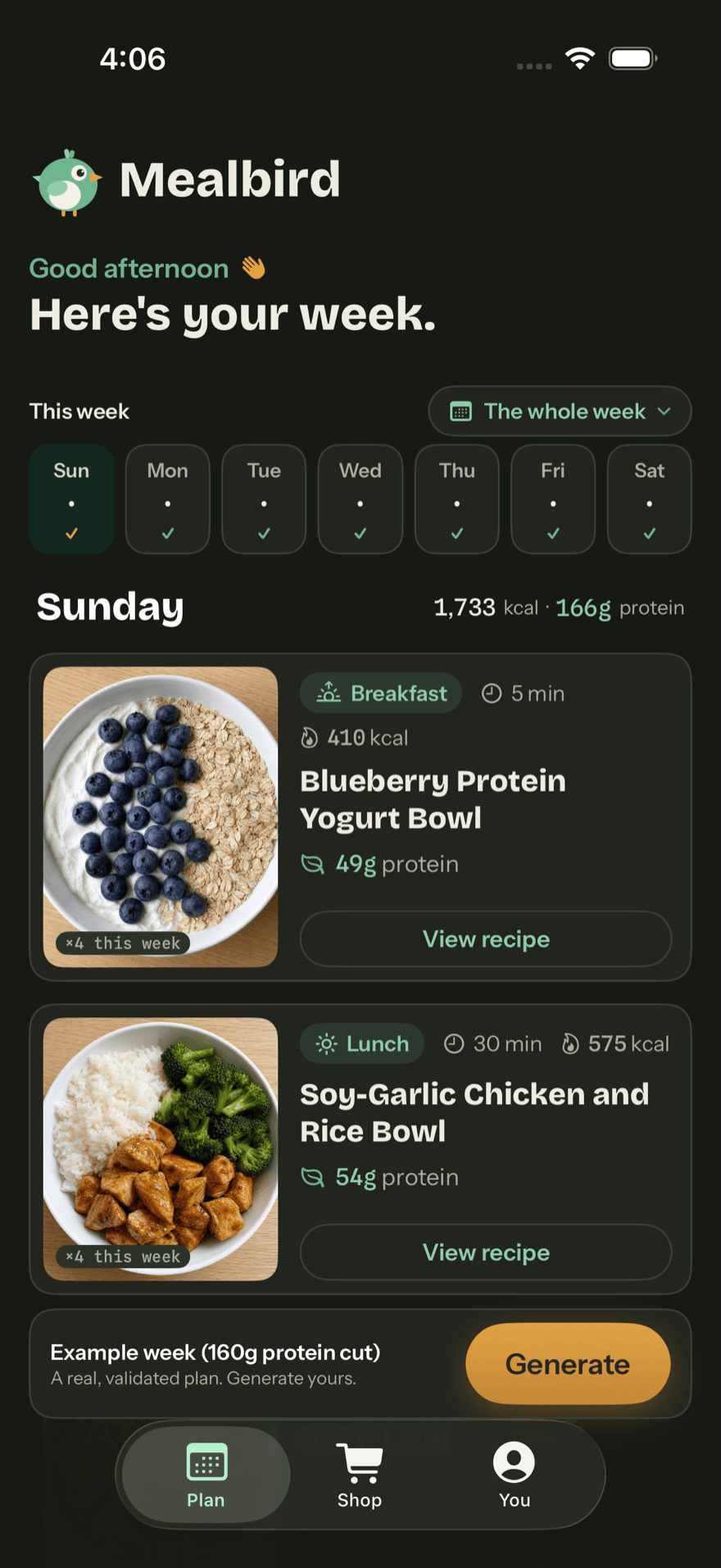
The meal planner that hits your protein every day
Mealbird plans a week of real meals on your protein and calorie targets, works out every number from USDA data, and writes the shopping list for your budget.


Free to download on iPhone and Android.
How much protein a day? Try it.
The same formula Mealbird runs in setup. Pick a goal, say who it’s for, and see the two numbers every day of your week would be planned to.
–g protein a day
–kcal a day
Pick a goal and your sex to see your numbers.
Counted for age 30 and 3–4 workouts a week. The app asks both, and the protein calculator shows every step of the formula.
Everything your week needs
From your targets to the till, one plan, checked by arithmetic.
Protein
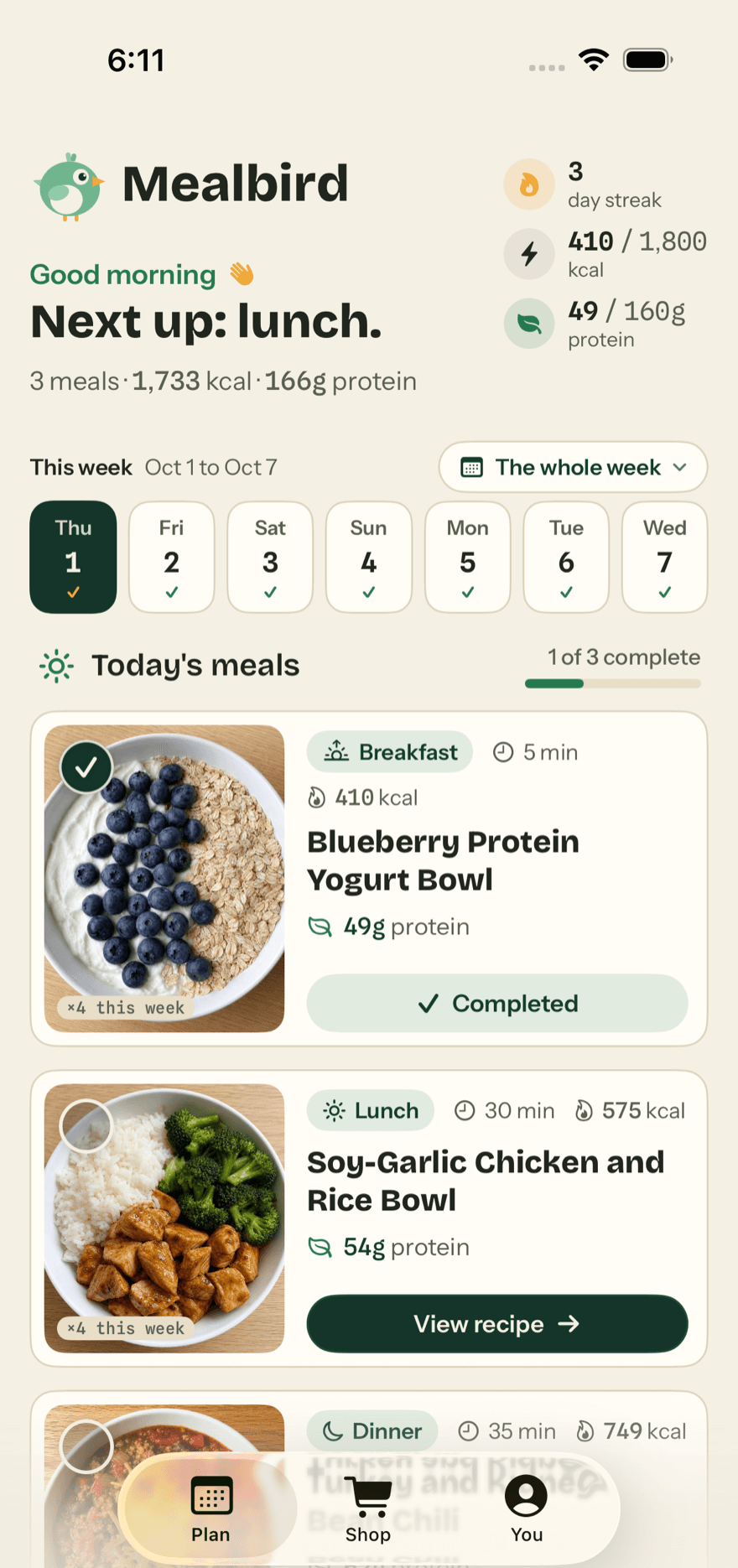
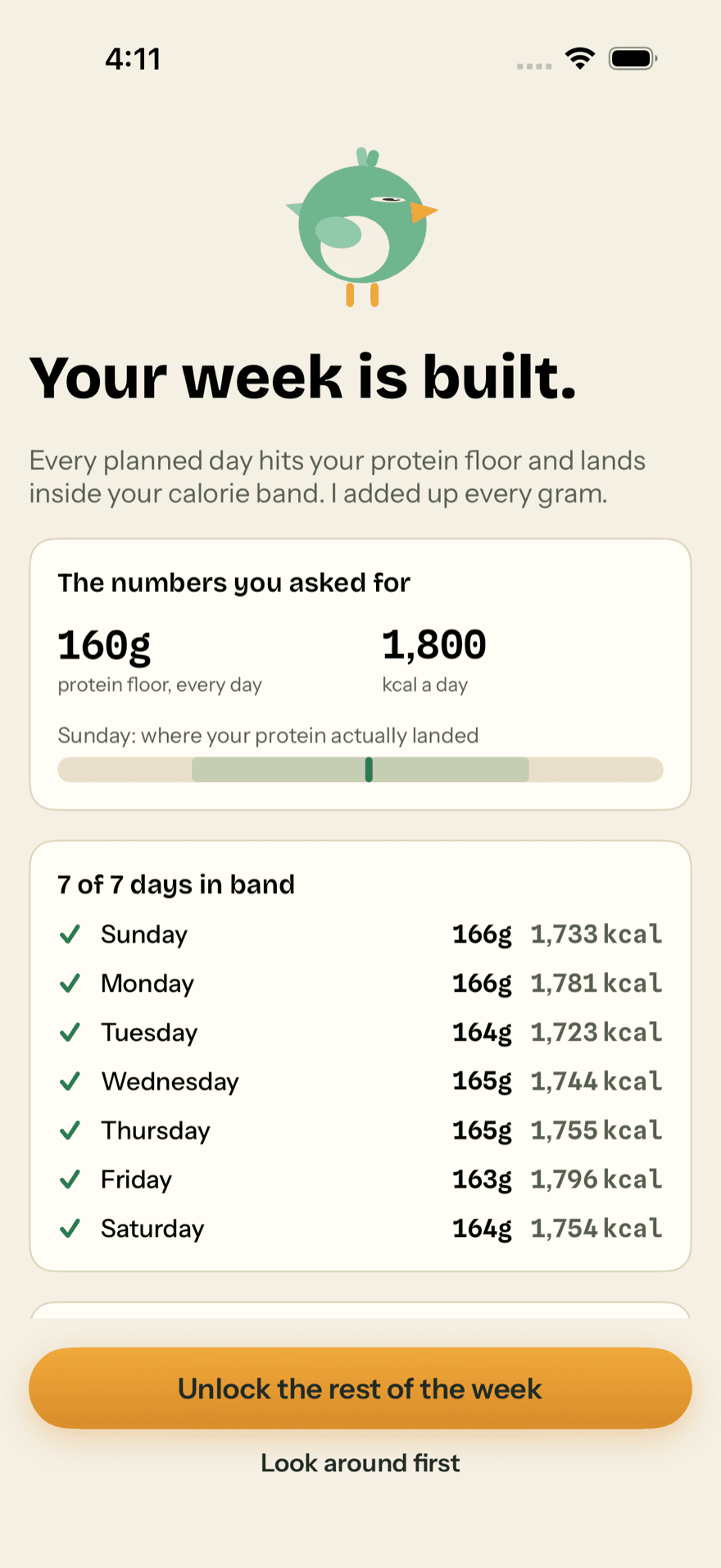
Every day checked against your protein
Seven days, each one checked against your protein floor and calorie band, not a weekly average that hides the short days. If a day can’t make it, the app says so.
Recipes
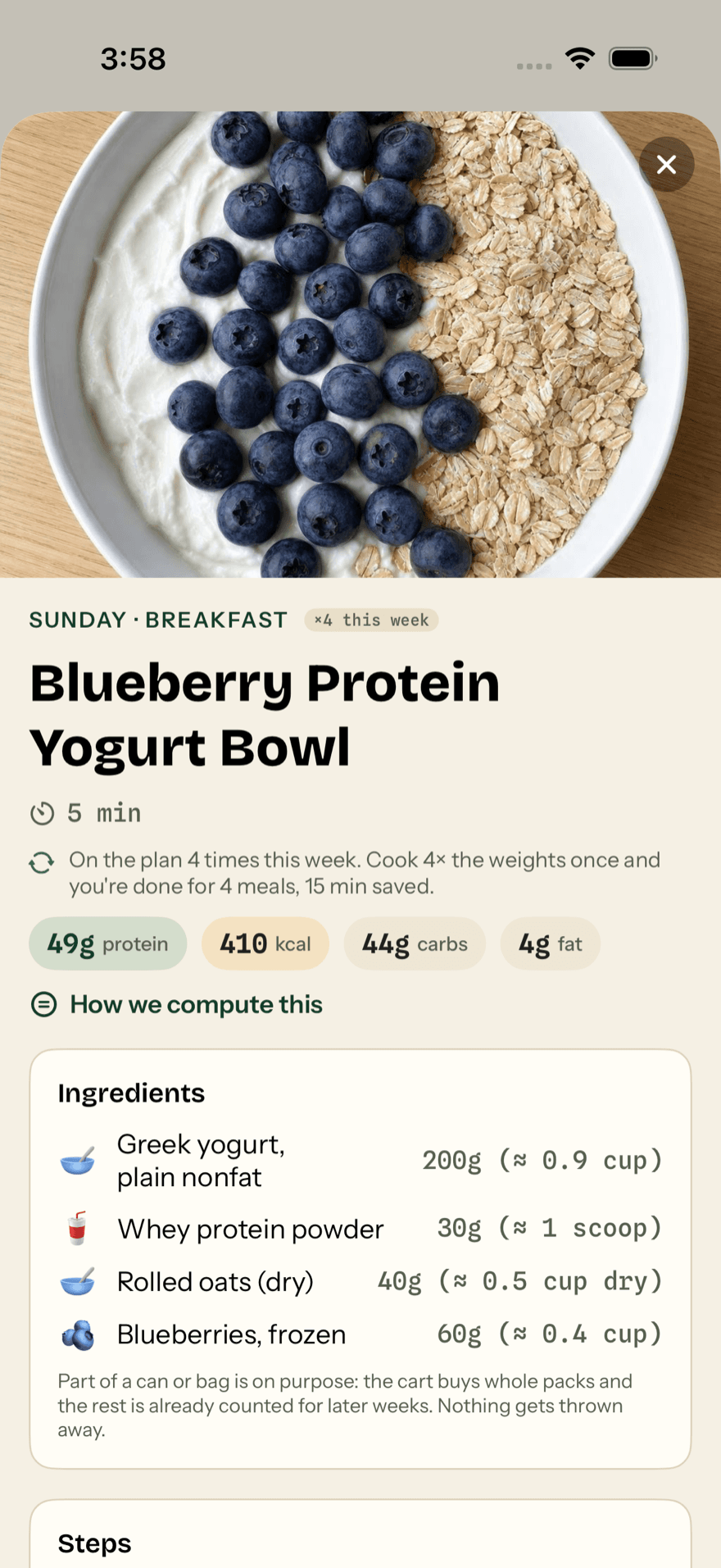
Recipes that show their math
Every ingredient to the gram, macros on every meal, the USDA arithmetic one tap away, and a note when one batch covers several meals.
Targets
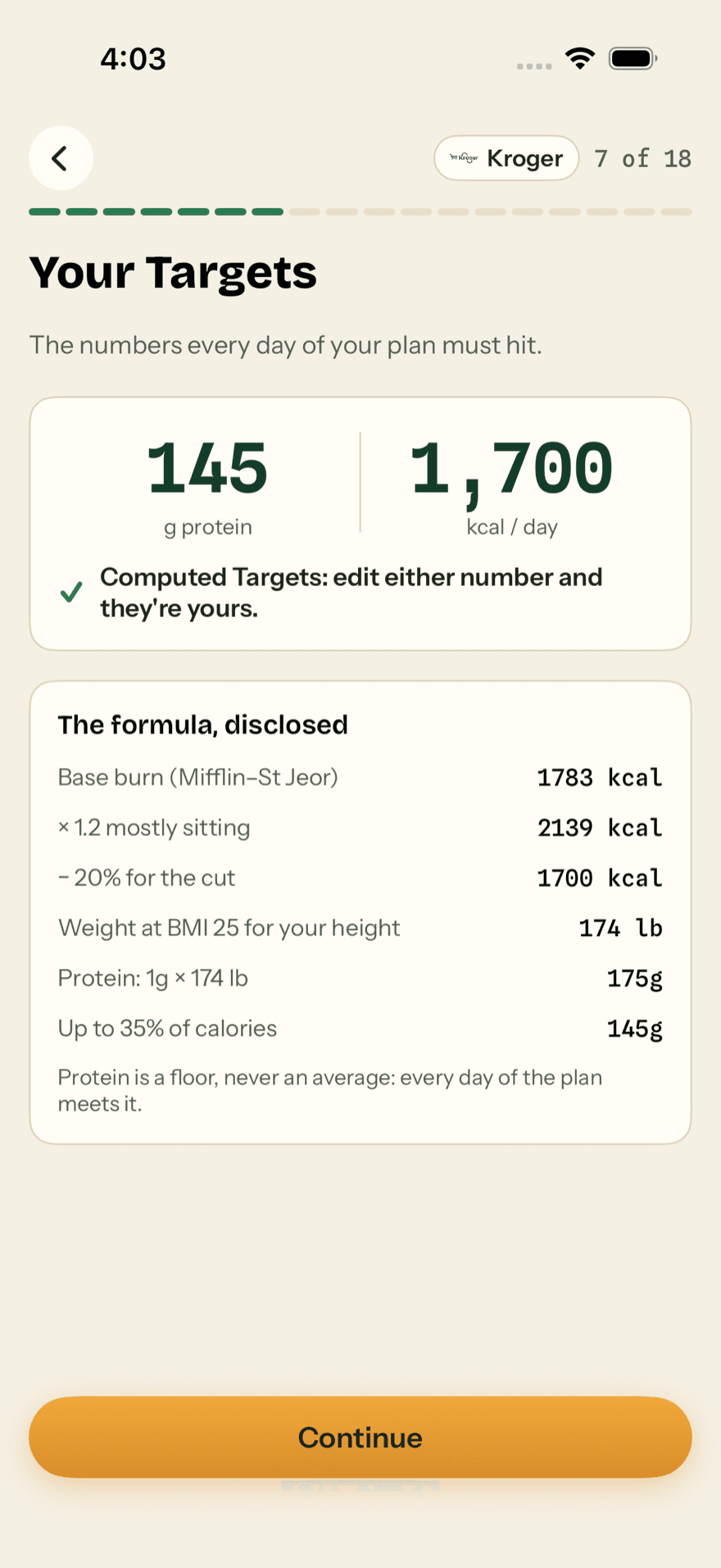
Targets you can read
Type your own numbers, or let the app work them out with a formula it shows you line by line.
Shopping
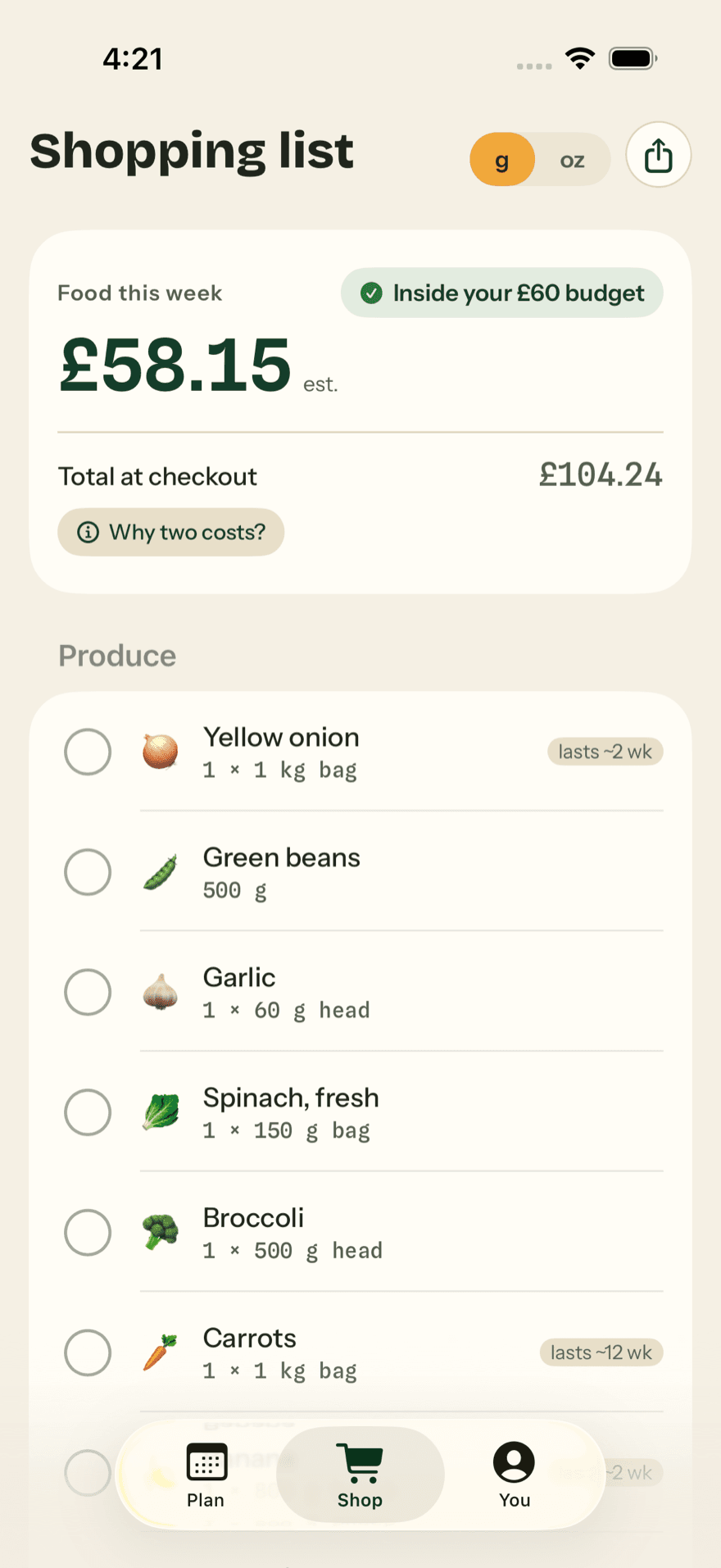
A list sorted by aisle, in real packs
How many packs to buy, in the sizes stores sell, and how long what’s left over will last.
Budget
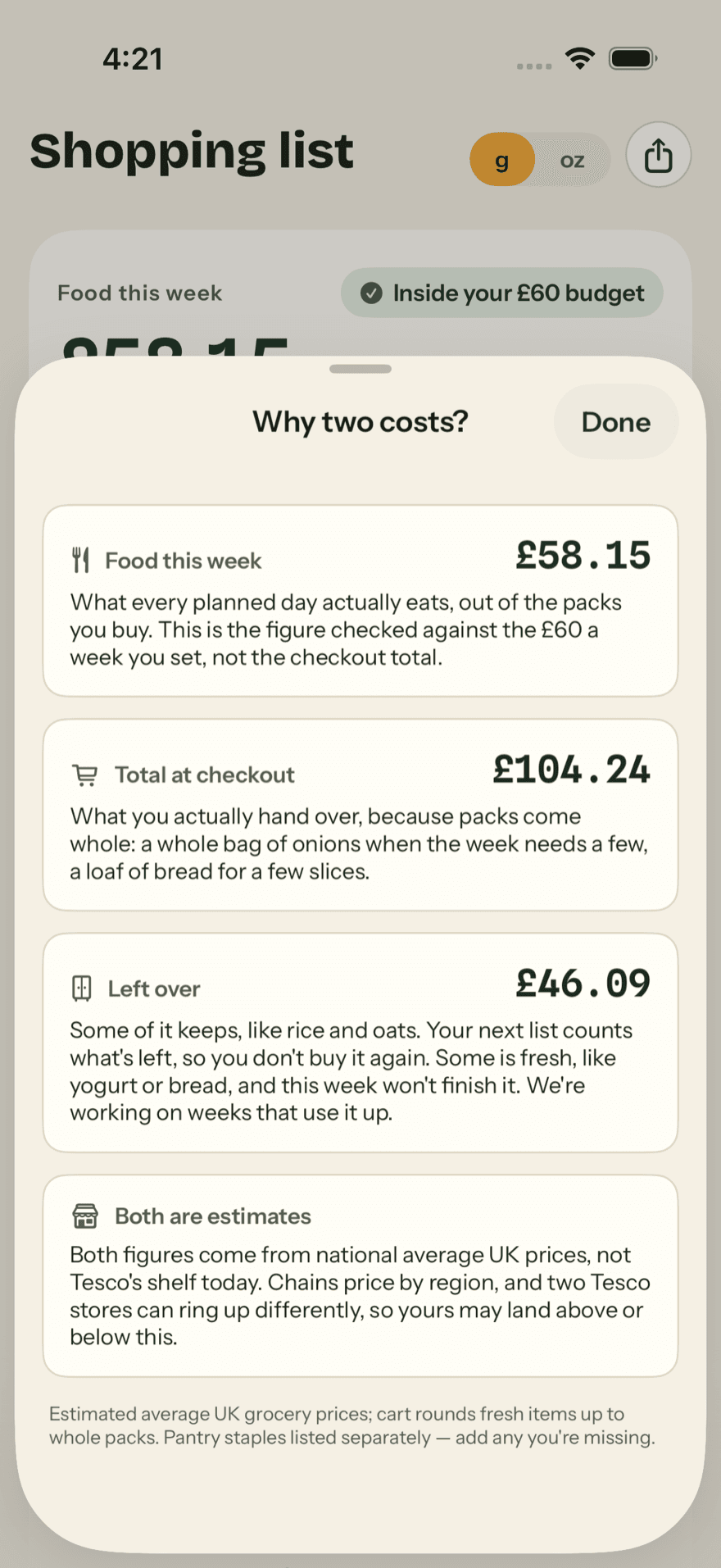
A weekly grocery budget
Set a number and the week’s food is planned inside it. Prices are labelled estimates, from local price tables in the UK, Ireland, the Netherlands, Belgium, Romania and the US.
Household
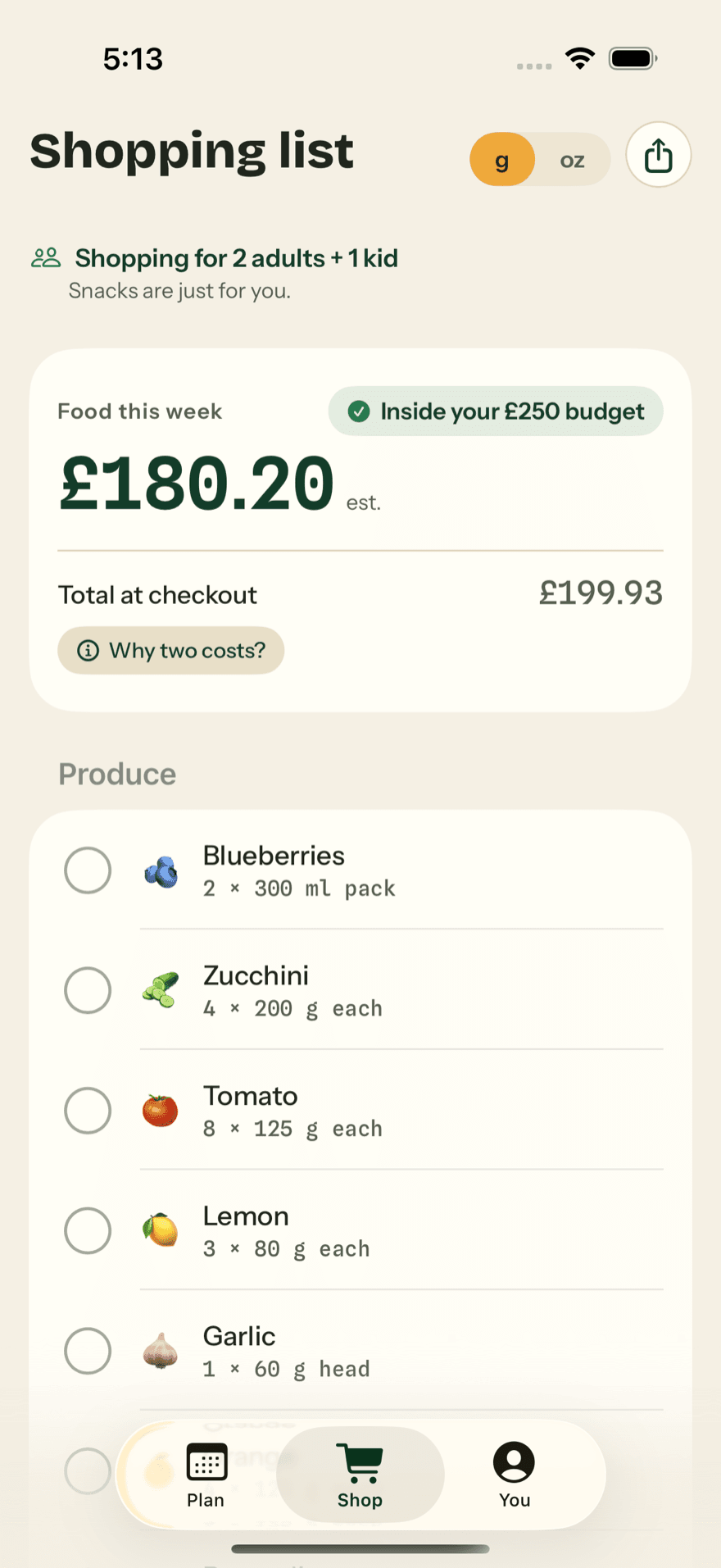
Cooking for more than one
Say who eats at your table and the shopping list buys for all of you. Recipes show your portion and the whole pot.
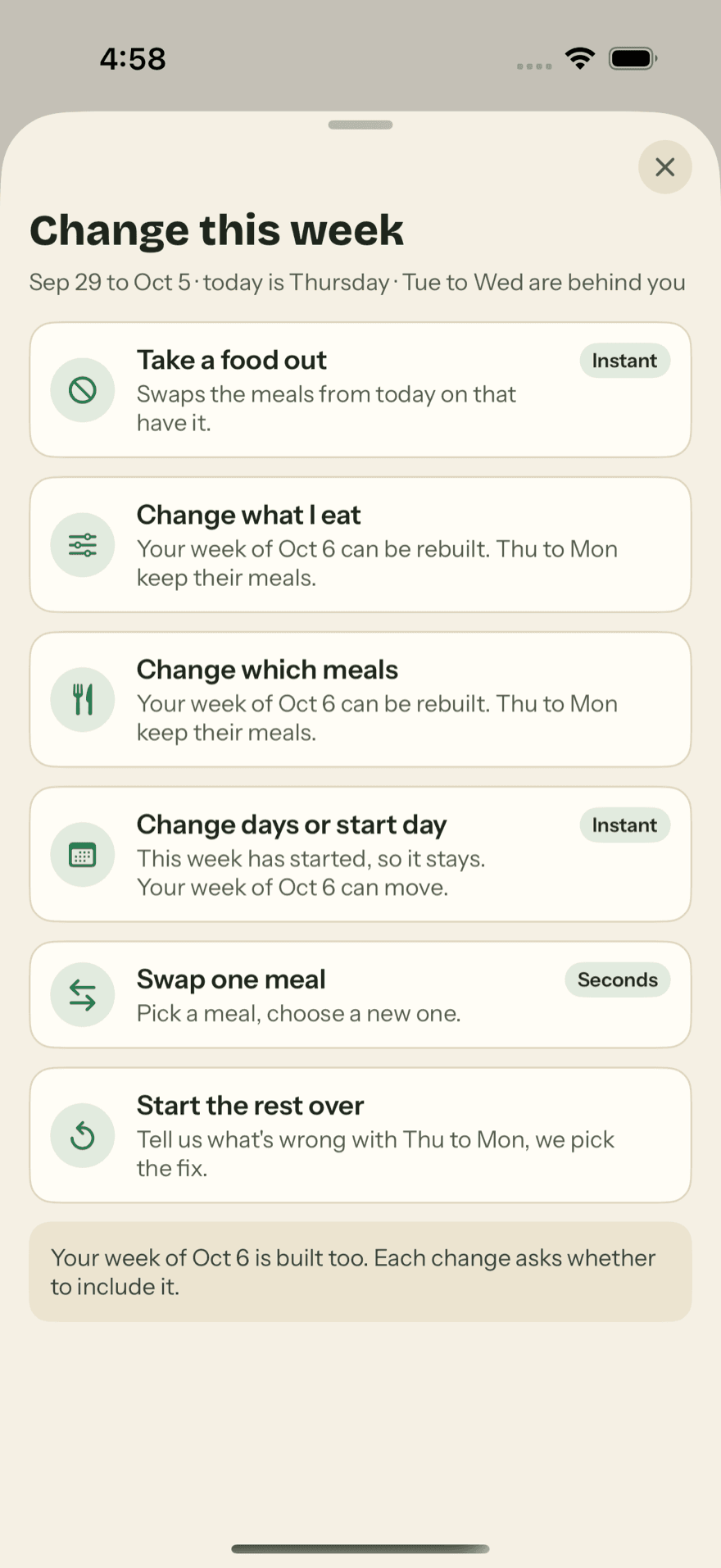
Changes
Change your week anytime
Take a food out, swap one meal, move your days or start the rest over. Eating out? Mark the meal, and the rest of the day stays as planned.
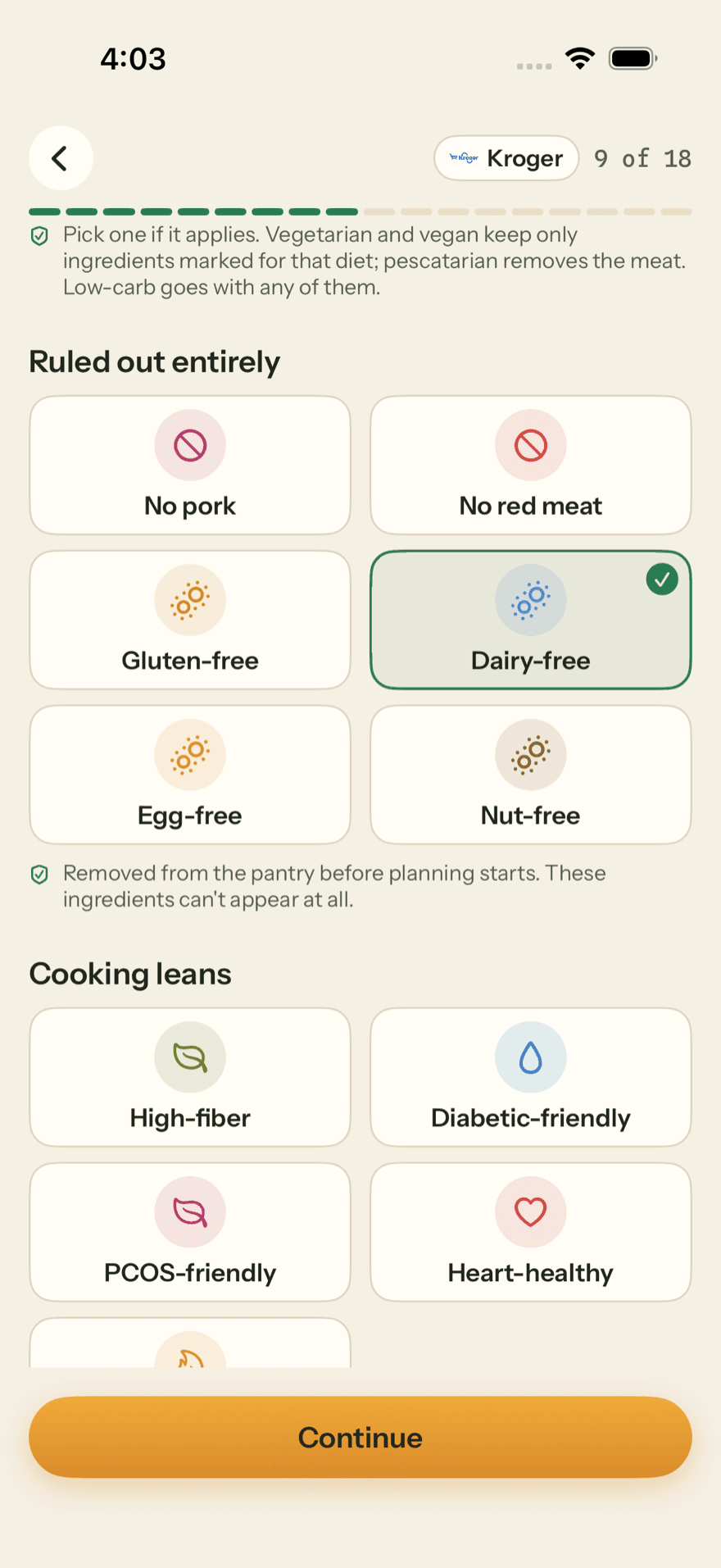
Diet
Your diet and allergies
Vegetarian, vegan or pescatarian. No pork, no red meat, low-carb, gluten-, dairy-, egg- or nut-free. Twelve allergens you can rule out completely.
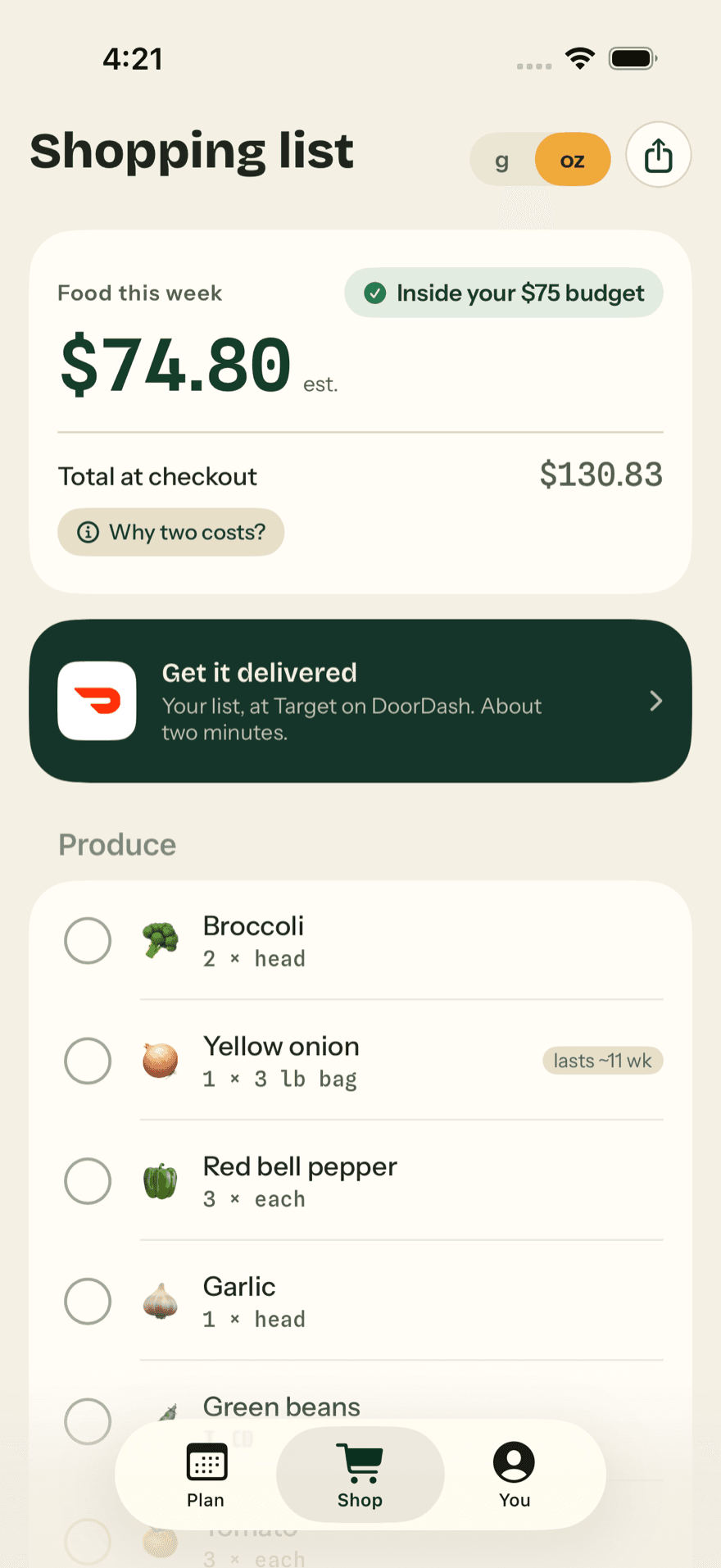
Delivery, US only
Your list on DoorDash
In the US, one tap copies the list and opens DoorDash on your store. Nothing is ordered until you check out there.
Not on Android yet.
AI meal apps guess. Mealbird does the math.
We re-added the numbers in popular AI meal planners. The plans looked confident; the arithmetic didn’t hold.
It said840 kcal
We added it up990 kcal
It said135 g
We added it up≈55 g
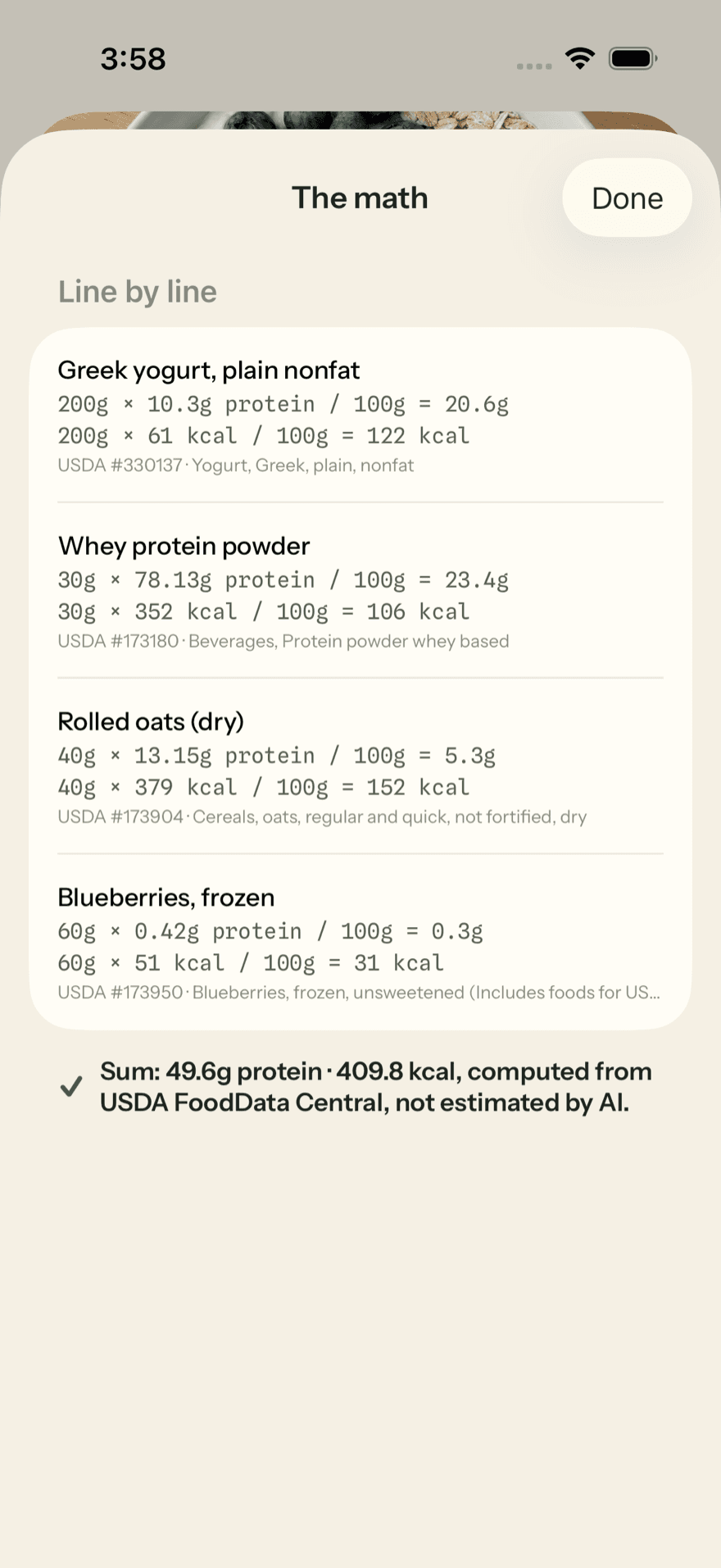
In Mealbird the AI only picks real ingredients and amounts. Every number in your plan is computed from USDA FoodData Central, and any meal shows its arithmetic, down to the USDA record.
Every day. Not on average.
A weekly average hides the days you fell short. Mealbird treats your protein as a floor all seven days have to clear. When your targets and budget leave no room for that, the week still arrives, with a notice saying how many days miss and by how much.
Every one of the seven days hits the targets — I added up every gram.
Protein 160–172g · 1,710–1,800 kcal · est. $74.80 groceries
How it works
Answer the setup questions
Your goal and body, your store and budget, your diet, and how much repetition you like. You see your targets before you pay anything.
Get a week that checks out
Seven days of real meals, each day checked by arithmetic against your protein floor and calorie band.
Shop once, cook easy
One list sorted by aisle, in real pack sizes, with the week’s food cost set against your budget.
In their words
App Store reviews, quoted as written. Translations from Dutch are ours.
5 out of 5 stars
Very good app for building muscle
I just installed the app and I am amazed how fast it is to plan the week if you want to build muscles. It tells you everything from every single detail, what to buy went to buy, went to cook how to cook and how to do meal prep. It’s a really good app. I highly recommend it.
App Store, Romania, Aug 6, 2026 4 out of 5 stars
Geweldig voor iemand die onregelmatig werkt
Fijne app, mis nog wel wat allergene of dieet wensen. Neem bijvoorbeeld ‘hallal’ ik heb een varkensvlees allergie en deze optie zou mij dus erg helpen. Verder ben ik enorm tevreden. App heeft potentie.
Our translation
Great for someone who works irregular hours
Nice app, though I still miss some allergy or diet options. Take ‘halal’, for example: I have a pork allergy, so that option would help me a lot. Otherwise I’m very happy. The app has potential.
App Store, Netherlands, Sep 28, 2026 5 out of 5 stars
Great for planning
I love this app! It helped me and my family get on schedule and on budget ! Awesome awesome !
App Store, United States, Sep 18, 2026 5 out of 5 stars
Raluca
A simple and useful app for meal planning and creating shopping lists. Definitely helpful for staying organized and making grocery shopping easier.
App Store, Romania, Aug 9, 2026
One subscription, the whole week
No free trial and no free tier. Building a checked week costs us real money, so we charge for it rather than pretend it’s free. Before you pay, the app lets you answer the questions, see your targets and open an example week.
- A week of meals on your protein floor and calorie band, every day
- Every recipe, with grams, macros and the arithmetic behind them
- The shopping list by aisle, planned inside your weekly budget
- Swaps and eaten-out meals that keep the rest of the day intact
- Your diet and allergies respected in every dish
Yearly
$29.99a year
About $2.50 a month. 75% less than paying monthly.
Monthly
$9.99a month
Renews monthly. Cancel before the next one.
App Store prices in the United States, October 1, 2026. Everywhere else the App Store and Google Play show the price in your own currency before you pay.
Billing starts the day you subscribe, and the App Store or Google Play shows the price before you pay. Both plans renew automatically and are billed by Apple or Google. Cancel anytime in your iPhone’s Settings or in Google Play.
Questions worth a straight answer
More in support, and the targets formula, worked line by line, in the protein calculator.
How is Mealbird different from an AI meal planner?
The AI never writes a nutrition number in your plan. It only chooses real ingredients and amounts; every gram of protein and every calorie in the plan is computed from USDA FoodData Central and checked by arithmetic. We re-added the numbers in the popular AI meal planners and they didn’t hold — one “840-calorie” dinner summed to 990, a “135g protein” serving contained about 55g.
Do I have to log or track my food?
No. You set your protein and calorie targets once and Mealbird builds a week that hits them, so there is nothing to weigh, scan or log after the fact. It is a meal planner, not a food tracker.
Can I set my own protein and calorie targets?
Yes. Enter your own numbers, or let a formula we disclose line by line compute them for you. Either way the targets stay editable, and changing them affects the next week you build.
Does every day hit my protein target, or just the week on average?
Every day. Your protein number is treated as a floor each of the seven days has to clear, not a total to balance out by Sunday. A validator checks all seven days against your bands. If your targets and budget don’t leave room for that, you get the week with a notice saying how many days miss and by how much, and we keep working on it in the background.
Where do the nutrition numbers come from?
USDA FoodData Central. Each meal’s protein and calories come from multiplying the grams in your portion by the USDA entry for that ingredient. Tap “How we compute this” in any recipe to see every line of the arithmetic, including the USDA record number.
How much cooking is a week of meals?
Less than twenty-one meals suggests. Mealbird reuses dishes on purpose, so a typical week is about 11 dishes covering 21 meals — roughly seven hours of cooking — and the app tells you upfront what repeats and what it saves you.
Are the grocery prices real?
They are labelled estimates, not live prices from your store, and the app says so everywhere they appear. In the UK, Ireland, the Netherlands, Belgium, Romania and the US they come from local price tables; anywhere else they are average US prices converted to your currency. The shopping list separates the food you will eat this week from what the packs cost at the till, because a bottle of oil comes whole and the rest counts toward later weeks.
Can I get the groceries delivered?
In the US, on iPhone, yes, through DoorDash; the Android app doesn’t have the delivery button yet. The shopping list has a “Get it delivered” button: it copies your list — pack sizes and our estimates included — and opens DoorDash on your store, where you paste it into the grocery search box once. About two minutes. If your store isn’t on DoorDash you pick one that is. Nothing is ordered until you check out in DoorDash, and DoorDash’s shelf prices and fees are its own — our estimate stays the in-store number. Outside the US there is no delivery button; the share button on the list sends it as text to your notes, a message or any other app, on iPhone and Android.
What does Mealbird cost?
There is a yearly plan and a monthly plan, priced in your local currency on the App Store and Google Play; the paywall shows the exact price before you subscribe. Neither plan has a free trial: billing starts when you subscribe. Both are auto-renewable subscriptions billed by Apple or Google, and you can cancel anytime from your iPhone’s Settings, or in the Google Play app under Payments & subscriptions.
Is Mealbird on Android?
Yes. Mealbird is on Google Play for Android 8.0 or later, and on the App Store for iPhone with iOS 17 or later.
Get your first week
On the App Store and Google Play now, in English, Nederlands, Deutsch and Română.